
First, Do No Harm
Evidence-based reporting and commentary on medicine, public health, infectious disease, vaccines, and health policy.
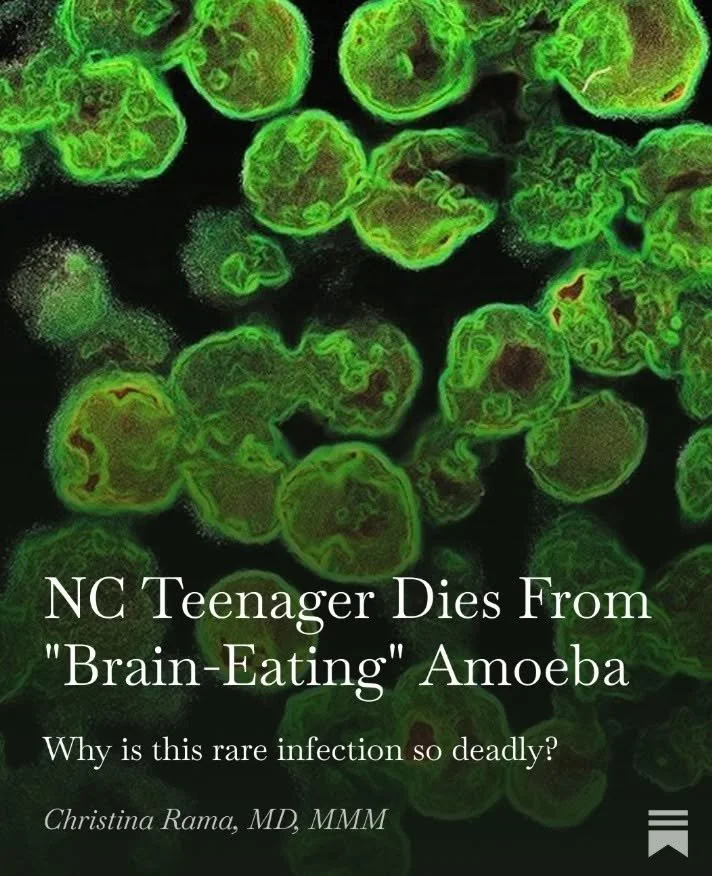

NC Teenager Dies From "Brain-Eating" Amoeba
Why is this rare infection so deadly?
The GoFundMe page shows a teenager lying on his hospital bed in a standard hospital gown, white with a small repeating geometric pattern. He is attached to a mechanical ventilator as a healthcare worker in blue latex gloves handles a piece of medical equipment, possibly a transcranial Doppler ultrasound probe. He has an IV in his left forearm. Scrolling through the uploaded photos, the boy is pictured from multiple angles, a close-up profile shows a tattoo on the left side of his neck and EEG electrodes attached to wires affixed to his head. His eyes are closed.
127 people have raised over $9,000 so far against a $10,000 goal. Many of the donations are anonymous.
According to his mother’s account, Moises, the young man pictured on the GoFundMe, began to have severe headaches prompting her to take him to a hospital on Friday, August 21, 2026. He was diagnosed with Naegleria fowleri the following morning at UNC Hospital. When the GoFundMe was published, Moises was in a coma fighting for his life.
The bottom line up-front:
Naegleria fowleri is terrifying, but it is also extraordinarily rare. Millions of Americans swim in lakes and rivers every summer without becoming ill. The lesson from Moises' death isn't that we should be afraid of freshwater, but that a warming environment may create more opportunities for this heat-loving organism. Simple precautions can reduce an already very small risk even further. Keep warm freshwater out of your nose, use only sterile, distilled or properly boiled water for nasal irrigation, and if severe headache, fever, vomiting or neck stiffness develops after recent warm-freshwater exposure, seek medical attention immediately and tell the doctor about the exposure. With PAM, time matters.
You can read more about N. fowleri, by going to my full Substack article.
If you like articles like this, like and share and consider subscribing to my free Substack which allows me to embed references.
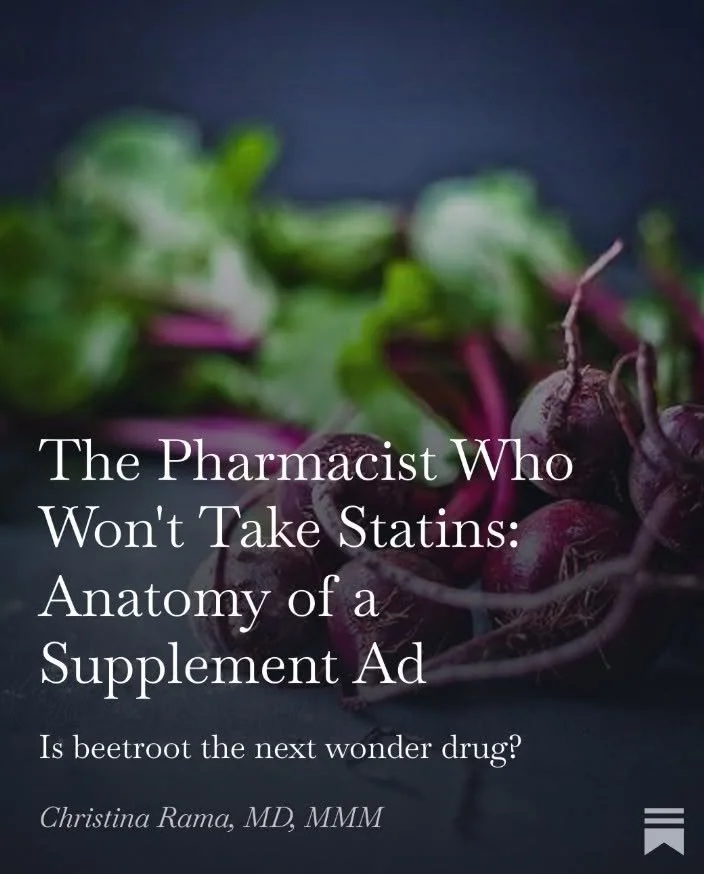
Is beetroot the next wonder drug?
A post from “The Heart Health Project” caught my eye. A woman dressed in green scrubs was squatting down behind a maroon car, trunk open and filled to capacity with beets. She was pointing at the beets, squinting and smiling at the camera. The post was captioned, “Support stamina and heart health every day.”
I read through the article, supposedly written by a licensed pharmacist named Karen Albrecht who claimed to have 27 years of experience and who was employed by a Rite Aid in Pennsylvania for the past 19 years. She claims to fill 340 statin prescriptions a week but won’t take one herself. She then touts her credentials (4 years of pharmacology, 2 years of clinical rotations) and insists she has read the package inserts of these drugs so often they are like “song lyrics.”
The article is a masterclass in subterfuge and marketing. And it also contains a few nuggets of truth. The “pharmacist” goes on to suggest people who take statins have God awful side effects, and then die despite taking their statins. She then talks about how her own doctor tried to put her on a statin, and how she did not get her statin prescription filled. Next, she describes how statins turn off CoQ10, and that this reaction accounts for the statin side effects people complain about (brain fog, muscle aches). She then tells us her LDL cholesterol is 172, and that she spent four months reading about LDL oxidation and what stops it at the arterial wall. The magic substance was “betalain,” found in the deep red pigment in beetroot. She claimed that betalain crosses into the LDL particle itself and neutralizes the oxidation from the inside. She then did more “research,” and found that modern beetroot sold in the usual big store chains is basically depleted of this wonder substance, because beets were selectively bred to be bigger, sweeter and therefore they have been diluted of betalain. Except for one variety of beets called Blutwurzel, which have been preserved by the Amish in Lancaster County. These magic beets contain 10-20 times the concentration of betalain found in other beets. The next few claims defy credibility. She drives out to the farm that still plants these wonder beets (but won’t disclose the name of the farm because she was “asked not to”). She tries to buy some of these beets, but the farmer tells her he doesn’t sell direct anymore because of the volume of demand, so he partnered with one company (Rosabella) to process the beets and make them into whole root beet capsules. Then the hook. The pharmacist’s LDL cholesterol drops 48 points. Then she hands out bottles of beetroot like it’s Christmas candy and everyone around her is amazed at success. She names names and laments the patients she couldn’t save with her miracle beetroot. Then 6 post-script “P.S.’s.”
The post has been shared 793 times.
Rosabella has an official affiliate marketing program, which means outside promoters can earn money for driving sales. The post I saw funnels readers to a specific Rosabella purchase URL rather than simply linking to a general informational website, which means whoever crafted the post is likely getting paid for every sale that originates when the link embedded in the post is clicked through. I can’t prove that, because there is no way to tell if the link in the ad is, in fact, an affiliate link…but I’d wager there is a financial payoff here.
The bottom line up-front:
Beets are great sources of nutrients. They contain betalains, which have antioxidant properties. The claim that proprietary sources of beetroot that contain ten to twenty times the concentration of betalain found in other beets and that this product is only sold by one company who has access to ancient beet seeds preserved by the Amish cannot be verified. Some experimental research suggests betalains can make LDL more resistant to oxidation, but there have been no clinical trials that have been sufficiently powered to establish that beetroot reduces hard cardiovascular endpoints such as heart attacks, stroke and cardiovascular death. Beetroot does have evidence that it increases nitrate/nitrite and nitric oxide availability (which causes relaxation of vascular smooth muscle and therefore can reduce blood pressure). Beetroot can modestly lower BP and improve endothelial function, although the trial evidence for this is a bit inconsistent.
You can purchase the beetroot on sale for around $19.98 for a one month supply but prices vary and can be markedly different from one website to another.
To read more about beetroot and what claims scientific data supports and what claims it does not yet support, read my full Substack article.
If you like articles like this, like and share and consider subscribing to my free Substack which allows me to embed references.
The Algorithm Says Eight Nurses. The Nurse Says Otherwise.
A friend sent me a screenshot of a meme that is being shared on social media that said: “One hour until nurses begin taking action in locations to demand Palantir OUT of our hospitals and our communities.”
“I’d love to hear your insight on this issue,” she said.
On Thursday, August 27, 2026, hundreds of registered nurses with National Nurses United (NNU), a labor union representing nearly 225,000 nurses, along with patients and community groups, staged a coordinated national action against Palantir.
The nurses are protesting Palantir for two main reasons.
First, Palantir technology is being used in hospital operations, including technology related to nurse staffing and scheduling. Their concern is that hospitals may allow algorithms to influence staffing decisions that require clinical judgment. Some nurses contend that algorithmic tools can contribute to inadequate staffing or fail to account for what is actually happening at the bedside.
The second reason is Palantir’s work with Immigration and Customs Enforcement (ICE), including its development of ELITE, a software application that helps federal agents identify and locate people targeted for immigration enforcement.
These are really two very different issues, so I think it is worth examining them separately.
Let’s unpack this. To read the remainder of this article, click the link below to go to my Substack: